Cellulose

October 6, 2011 in Plants

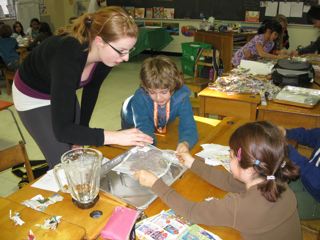
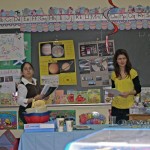
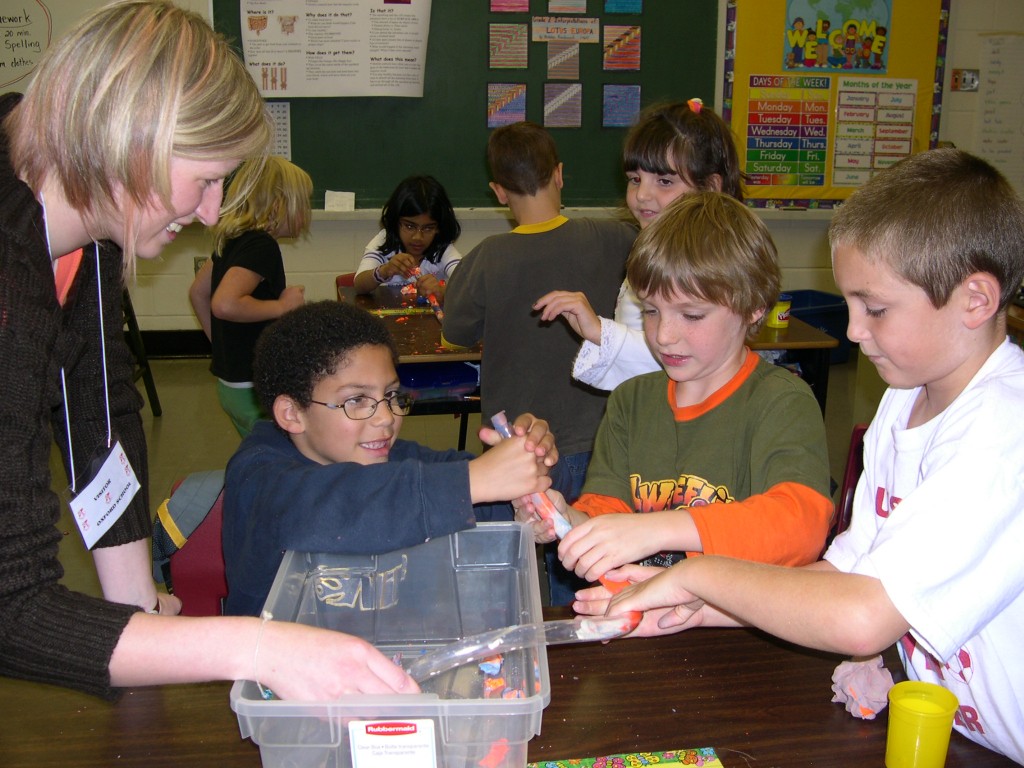
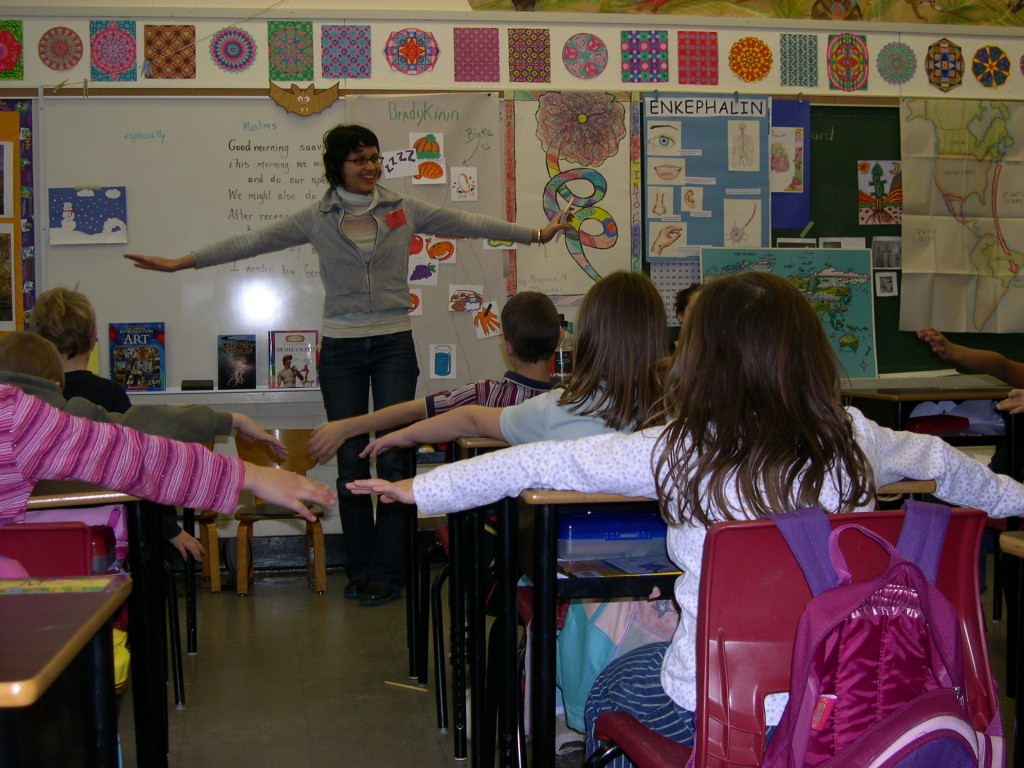
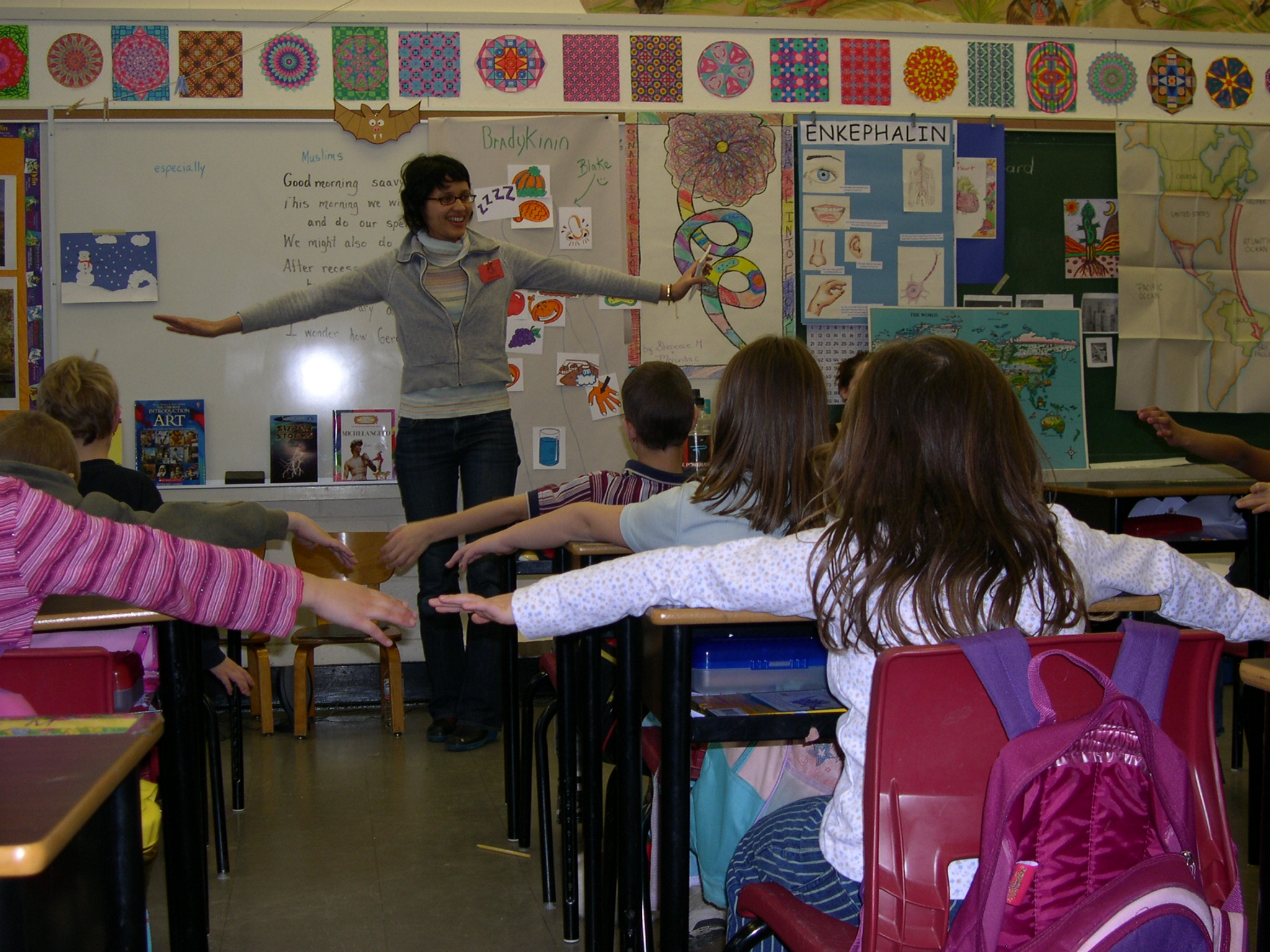
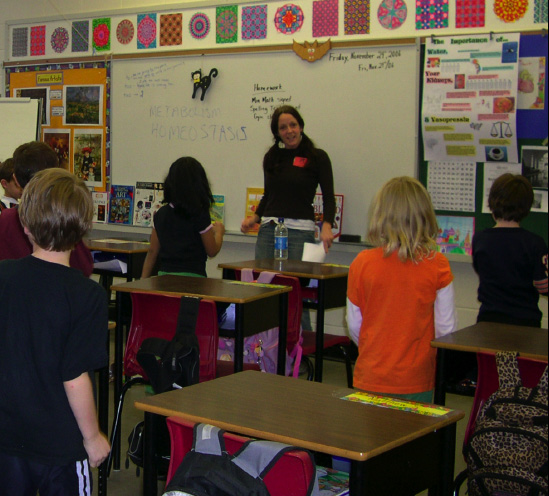
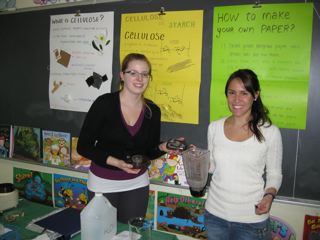
Like a tree, Molecules of Life grew into its 4th academic year, thanks to that the ever popular, multi useful , abundant natural product, cellulose, which was presented to Ms Sanchez’s 3rd grade class at École FACE School on Wednesday the 18th of November, 2009, by MoL Team Cellulose, Kim Beauregard (MSc student U Montréal) and Diana Rodriguez (Master student of Art Education, Concordia).   Introducing cellulose, as a linear chain of sugar units , a principal component of cotton (90%) and wood (50%), Kim was pleased to see the students identify the many items made using this versatile polymer: clothing, paper, desks, chairs, the classroom door… and mentioned further the presence of cellulose in the thin transparent film, cellophane and the semisynthetic textile, rayon.   For comparison, Kim also introduced starch, another polymer of sugar (glucose), which because of a difference in chemical linkage geometry adopts a spiral structure, instead of the linear cellulose strand.

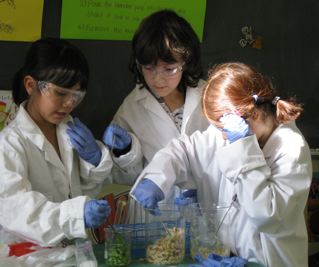
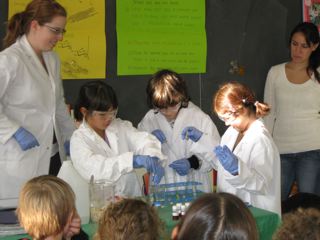
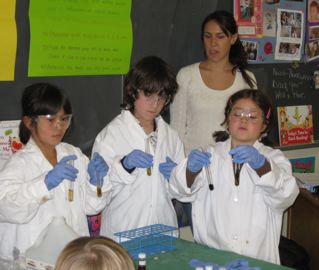
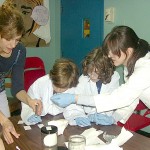
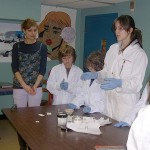
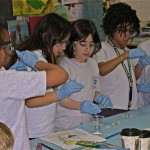
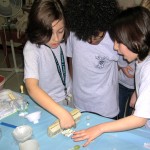
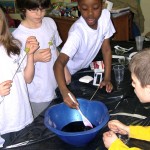
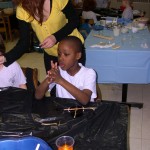
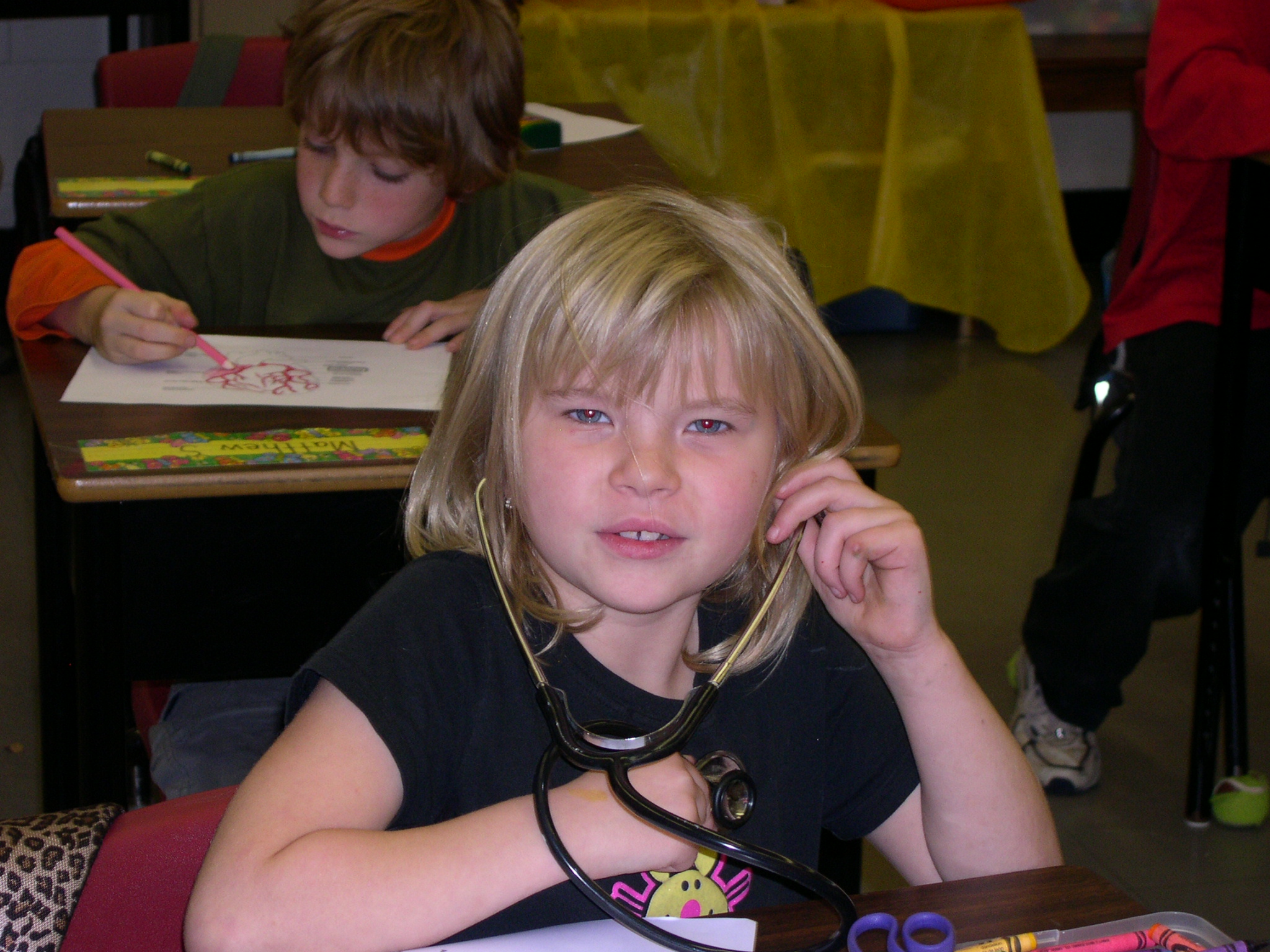
The students then ground up a series of food samples (banana, celery, potato and bread) and compared them with sugar in a starch iodine test.  After a brief discussion of lab safety, three students put on lab coats, lab glasses and gloves, and performed the test which produces a dark blue-black color in the presence of starch, the helical structure of which enwraps the iodine.

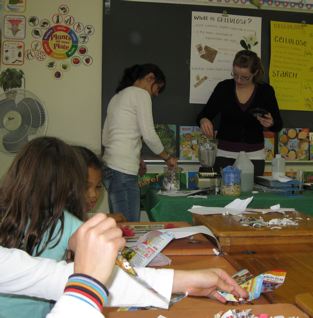
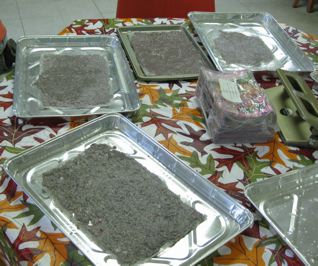
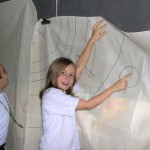
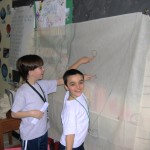
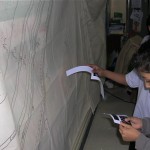
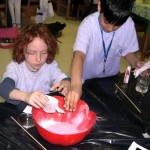
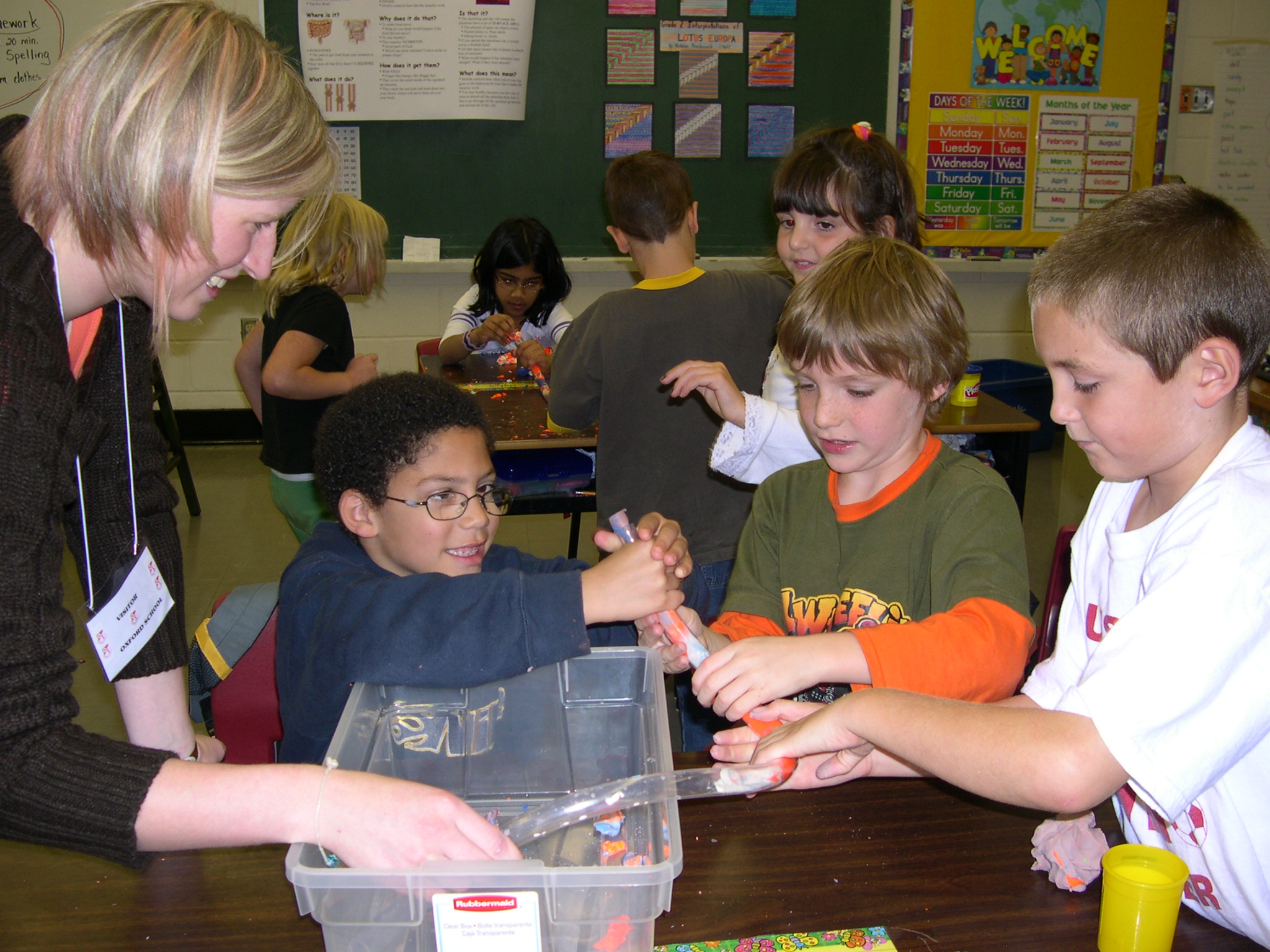
The utility of starch as glue for binding paper fibers was next demonstrated by Diana, who taught the students how to recycle paper. Shredding old newsprint, cardboard and old note paper, the students then watched their shredding mix in a blender with some corn starch to form a paper paste which they applied to screens to produce new sheets of hand-made recycled paper.

Discussing cellulose and starch, the students learned that although cows and termites can eat wood, it is the symbiotic micro-organisms that live in their guts, which allow these animals to digest the cellulose into the sugar needed for energy.  On the other hand, humans cannot digest cellulose, which serves as ‘fiber’ to help digestive flow.

Happy to do some first hand recycling, the students thanked team cellulose for exposing them to the many products and properties of this key component of many of life’s simple comforts and food,


For more information about cellulose see: http://en.wikipedia.org/wiki/Cellulose

For more on the Starch – Iodine test see: http://www.elmhurst.edu/~chm/vchembook/548starchiodine.html

Resource for teachers about cellulose : http://moleculesoflife.ca/?p=931


Carotenoids

October 6, 2011 in Plants

On Friday, December 5th, 2008, the combined English and French fourth grade classes taught by Ms Reavell and Ms Breton at École F.A.C.E. School were exposed to the wonderful world of natural color as they were introduced to the carotenoids and vitamin A, thanks to university students Jess Aylsworth (BA Art Education, Concordia U), Tanya Godina (MSc., U. Montréal), Maya Grubisic (BA Art Education, Concordia U), and Zac Kenny (BA Art Education, Concordia U).  First, we reviewed what we had learned about sulfur and bonding from the MLP last Friday.  The students were quick to identify the presence of sulfur in foods and one student even described accurately hydrogen-bonding between two water molecules. Tanya and Maya led the class from talking about weak bonds that could be changed by heat to weak bonds that can be changed by light energy as we entered into a bilingual discussion of the carotenoids.

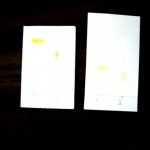
The students were quick to identify that the carotenoid, carotene was present in carrots which were a good source of vitamin A, which Tanya explained was produced from carotene in the body and is used by the eyes to see.  Four student volunteers attired in proper lab-wear then  performed chromatography on paper and glass plates coated with a thin layer of silica gel to see if the carotene in carrots could be identified in spinach.  The students ground up the vegetables and with a little acetone, they extracted enough sample to spot slightly above the bottom of their paper and plates.  The spotted paper and plates were then placed in chambers containing a solvent which eluted the color spots up the plate.

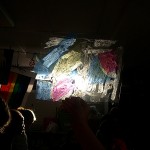
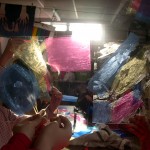
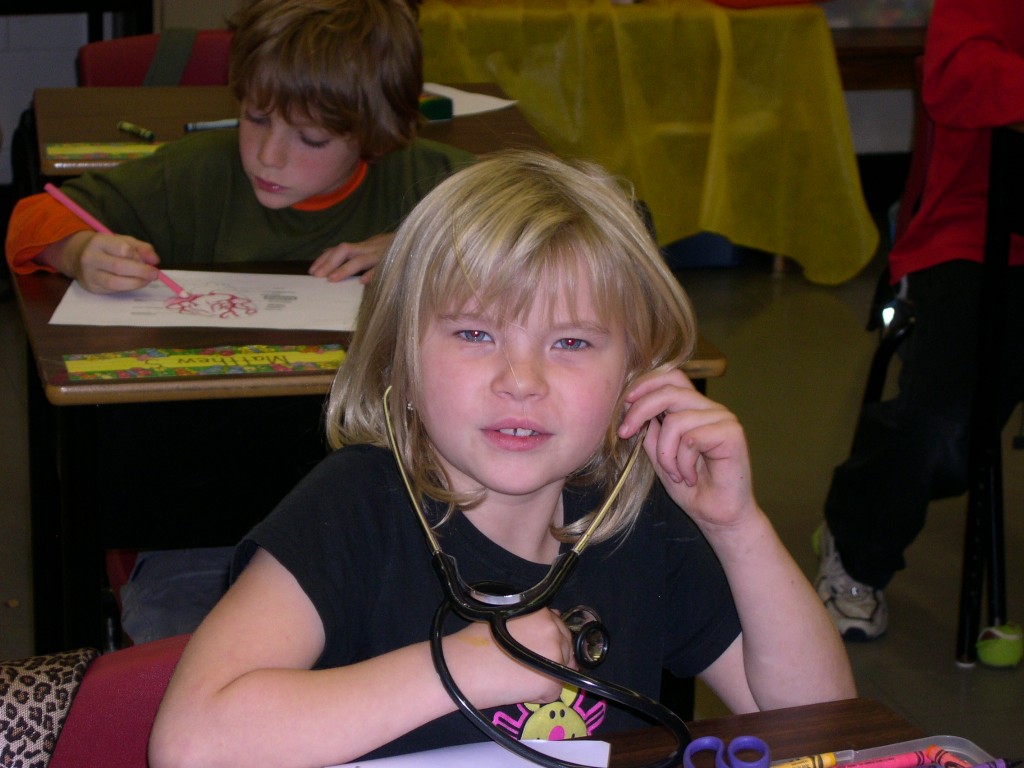
As discussed, the spinach too possessed a yellow color spot which moved up the plate faster than the green chlorophyl to the same distance as the yellow carotene spot from carrots.  Hence, there seems to be carotene in spinach too.  The students recognized that in Fall, leaves change colors as chlorophyll production slows to a halt and eventually all the chlorophyll is destroyed, unmasking the yellow, orange and red colors of the carotenoids.    Noting the importance of the carotenoids in absorbing light to provide color and vision, the students made their own light catchers by employing different colored cellophane in a transparent collage.   We thanked Team Caratenoid for their illuminating presentation.

Titan and Europa

October 6, 2011 in Space

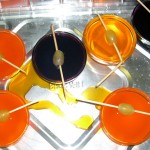
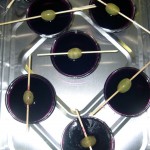
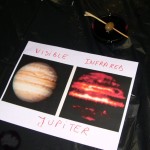
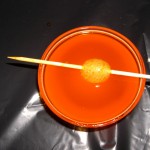
On Wednesday, April 1st, 2009, the Molecules of Life Project voyaged “where no one has ever gone before” to the moons of Saturn and Jupiter stopping on Titan and Europa.  Guided by Université de Montréal Chemistry BSc student Alexandra Cadar and Concordia University Bachelor of Art Education student Catherine Chen, Ms Schuster’s 3rd grade class from École FACE School toured these moons in search of extra-terrestrial life forms, or at least the astrochemistry that suggests that there may be life there someday in the future.   Alexandra and Catherine led an interesting discussion on the atmosphere and chemical compositions of the moons and a comparison with those of Earth.  The students knew a lot about what is necessary for life on earth.  They were fascinated to learn that Europa consists of a smooth white ice outer crust  under which lies an expansive and very deep salt water ocean that surrounds a mineral core.  They recognized that water and oxygen, which are found on Europa, are essential for life.   Titan, they were told may resemble Earth several billion years ago, possessing simple organic molecules such as methane and volcanoes that spew  “lava” containing water and ammonia. They were interested to learn that the atmosphere on Titan consists almost entirely of nitrogen which is also the most abundant gas of the atmosphere of Earth (78% nitrogen and 21% oxygen).   But, how do scientists know what is on these moons which are hundreds of millions of miles away?  ”Spectroscopy” (the study of the interaction between electromagnetic radiation and matter) was described as the tool astrochemists use to study the moons, and the students showed their basic knowledge of radio waves, microwaves for heating, cats that see in the infra-red, the rainbow colors of the visible spectrum and X-rays which they had taken when they broke their bones.  With six volunteers, Alexandra showed that some molecules like caffeine which appeared white in visible light, glowed violet under a UV lamp.   Catherine then showed how the students could make a model of these moons using a grape for their core, jello of various colors to represent the compositions of the different atmospheres and a glass bowl for the icy outer crust.  Sculpting with jello, searching on maps of Saturn and Jupiter for the locations of their different moons and examining the spectrum observed for each moon, the students were very thankful to experience more astrochemistry care of Team Titan and Europa.


For more info and facts on Titan and Europa see: http://www3.signonsandiego.com/stories/2009/mar/16/1c16moons191744-moon-eyed/

What is the composition of jello, a hydrogel of edible proportions see: http://van.physics.illinois.edu/qa/listing.php?id=487